Showing posts with label Holocaust. Show all posts

Monday, February 1, 2010

Book Bites: The Good and the Not-So-Good

Let's begin with the not so good.

Kurt Vonnegut's Breakfast of Champions is our first book club read of 2010 which will be discussed tonight. I cannot wait to hear what everyone thinks about it! We have a journal in which information from each meeting is recorded, quotes and such. I suspect my quote of the night will be this:

This is 0% of what I am looking for in a reading experience.

Shall I elaborate? I just couldn't stand anything about this book. The writing style, the story itself, the mention of every one's race in a 'hey I'm not racist but everyone else who mentions race is' way, the bizarre mention of the length of the genitals of every male character. What the heck was that all about?? I think I 'get' Vonnegut's point, that this is a satire on 'modern' society and it's ills, but overall it felt like a waste of time. Not funny. Not entertaining. Sort of gross. Just annoying. The only positive thing I would say about it was that occasionally this 1973 book felt current. I wouldn't have finished this book had it been for my husband who has been bugging me to read Vonnegut for years. He thinks I'm nuts. So would all the reviewers on Amazon who love this sort of thing. Maybe you think I'm nuts, too. I don't care. I won't be reading any more Vonnegut, but it seems he has plenty of fans already.

On to better things.

Day After Night: A Novelis Anita Diamant's new book which perhaps I wouldn't have read for some time, but I came across a copy at the library. The library has been my friend in 2010! Anyhow, Day After Night is set in an interesting time period, that just after WW2. I've read a fair number of holocaust books, but I've rarely read detailed accounts of what happened to the many survivors after the war was over. We know they didn't just go home and resume their lives. Day After Night is set in Atlit internment camp in Palestine; basically another prison for those who had just been freed from persecution. The story focuses on four women with varied stories, as they experience Atlit and eventually their rescue/escape from it into Israel. I enjoyed this book and thought Diamant did an excellent job bringing this bit of history alive by making it personal through the characters.

On another subject, can I just say that this blogging change that I talked about in November is working for me. I am happy with the amount of time that I spend blogging and reading the blogs of others. I am commenting less but it means more if you know what I mean. I am very happy with the reading choices I have been able to make and the fact that I have very few books that need to be read on a time frame. My reading feels like me again, instead of feeling like I am following the herds reading the same things. It feels good.

Tuesday, September 29, 2009

Those Who Save Us

I'm freezing! Brrr. I feel bound and determined NOT to turn on the heat in September, however at the moment my bedroom is a brisk 62 degrees. We'll have to see how I feel when I arrive home from work at midnight.

My bookclub has had its fair share of duds this year. At our next meeting we'll be discussing Jenna Blum's Those Who Save Us. Here was something I could finally sink my teeth into.


Those Who Save Us is the story of Trudy and Anna. Anna is Trudy's mother, a German immigrant who was never really accepted in the small town of Minnesota where she lived. Trudy is her daughter, a professor of German studies, who has lived her life wondering why her mother won't talk to her about her father and her past. Thanks to a photograph she found with her mother's things, Trudy believes she is the child of a Nazi officer.

Told in alternating story lines, we learn Anna's past and Trudy's present. I think I enjoyed Anna's storyline more, desperate as it was. Anna's story feels unexpected and it is no wonder that she has chosen to remain silent. Though free during WW2, she suffered and paid a price for survival. Trudy embarks on a video project with a colleague who is recording stories of Jewish survivors. Trudy in turn begins recording stories of Germans who lived through the war. The tales she hears vacillate from greatly disturbing to life affirming. The ending comes as a bit of a shock, we know that Trudy will eventually discover what her mother went through, and the end is positively gripping as things are revealed.

As I mentioned above, this story takes place in Minnesota. When I read a book set in a place where I live or have lived, I never fail to wonder if because I am familiar with the place, the details of place stand out so much to me. I cannot tell from Blum's biography if she has ever lived here, but I can tell you that she has the details spot-on. When she writes about the cold, and how it seems your lungs are going to shatter when you breath in, well, I know she knows how cold it really is here.

This was an absorbing read for me and one of the highlights of our bookclub in 2009. I can't wait to hear what everyone else thought.

Monday, April 13, 2009

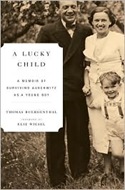
A Lucky Child


Thomas Buergenthal has indeed had luck play a role in his life, as he writes in A Lucky Child. Born in Czechoslovakia to German and Polish parents, Buergenthal had a few idyllic years growing up in the hotel his family owned. Hitler and the Nazi regime changed all that when he was still a small boy, turning his family out of their home. They journeyed to Poland where after a time they were placed in a Ghetto and eventually were transferred to Auschwitz. Buergenthal arrived in Auschwitz a ten year old boy, miraculously escaped the selection process and found himself a prisoner in a place where children did not fare well. Burgenthal survived the death march and another concentration camp before he was set free.

The story of Thomas Buergenthal is extraordinary in many ways. I cannot say I've ever read about a child surviving Auschwitz. Time and time again, the quick-thinking and creativity of his parents, and the luck of being in the right place and meeting the right people (or perhaps not being in the wrong place or meeting the wrong people) contributed to Buergenthal's capability to survive another day, to escape another close call.

Buergenthal goes on to travel with the Polish army after the war and is eventually and happily reunited with his mother after living in a Jewish orphanage. The portrait he paints of his life in Germany after the war is fascinating as well, being one of only a few Jewish people in his town. Buergenthal eventually emigrated to the US where he became a lawyer devoted to upholding international human rights, a job he is uniquely qualified for.

Buergenthal's story is simply told. He is honest about what events he remembers and which are not as clear. Buergenthal is an articulate and self-aware human being, who has shaped his life around avoiding hatred and upholding the rights of all. We are lucky indeed, to have this memoir, a unique document of a child who survived the Nazi concentration camps.

Many thanks to Hachette Book Group for this review copy. A Lucky Child will be published on April 20.

Tuesday, September 30, 2008

The Pages in Between


A Jewish baby is born in a Polish ghetto in 1942. In an attempt to save her life, her father asks a Polish gentile woman to look after his young daughter, telling her that he'll be back after the war. Indeed he does return and these two are some of the only members of their family who survive the holocaust. The frightened little girl and her father, a stranger to her, go to Sweden for a few years and then on to the United States where this little girl grows up, marries, and becomes a mother.

Erin Einhorn, a reporter, must have known she had quite a story on her hands, or at the very least a fascinating family history, because the little girl in the story was her mother, Irene Rozenblum Einhorn. Despite her mother's long reluctance and disinterest in speaking of her past, Einhorn is determined to find out who this family is who saved her mother and made her own life possible. This story has become The Pages in Between, an honest and revealing memoir which winds up going in a direction that most holocaust writing does not. Einhorn moves to Poland and is surprised to find that in this country that was ten percent Jewish before WW2, Judaism has now become trendy. There are Jewish restaurants and trinket shops and tours one can go on.

Einhorn visits Bedzin, the previous home of her family, and quite easily finds the house they used to live in, and in it, the family that saved her mother's life, the Skowronskis. The woman who cared for her has died, but her son lives there with his family. He remembers the little girl he thought of as his sister whom they had always hoped would return for a visit. Einhorn visits the family multiple times, taking a translator with her, and over time some frustration on the part of the Skowronskis is revealed. Einhorn learns there is a problem with ownership of the house, and the Skowronskis want to collect on a promise made by Einhorn's grandfather during the war.

Einhorn tries to do what she can to help them, and it turns out to be a terribly complicated and potentially expensive legal matter. At the same time, Einhorn is struggling with the somewhat turbulent relationship she has always had with her mother as well as some life-altering news.

I found this to be a quite compelling story and I enjoyed Einhorn's personal tone throughout the book. I was very impressed with the degree to which she tried to assist the Skowronskis. I felt as though they were giving her a pretty hard time and it would have been easy for her just to walk away. It's an interesting question, really. After what happened in the Holocaust, do people really owe each other for saving a life, or was it just the right (and obviously brave) thing to do? Who should property belong to? The people it was stolen from over 60 years ago, or the people who have since made it their own?

I found this to be a fascinating and unique story and recommend it.

Friday, August 15, 2008

On Hitler's Mountain


On Hitler's Mountain by Irmgard A. Hunt is the memoir of a woman who grew up in Germany during the reign of Hitler. She lived in a small Bavarian village that was overlooked by Obersalzberg, a hamlet where Hitler built his home and headquarters. On Hitler's Mountain begins with the story of Hunt's grandparents and parents who lived through WW1 and had never been in a financially stable position. The experience of this family, and probably many others, helps to understand in some ways how they came to elect Hitler German chancellor despite knowledge of his anti-semitism. This is an interesting book on many levels - growing up in Bavaria, growing up in Hitler's Germany with parents who supported Hitler, and especially life in occupied Germany after the war. I had really never understood before what happened when the allies occupied Germany, so the reading of this as well as additional research has been a good education for me.

This book is an important document, I think. I'm certainly not aware of many other books detailing life inside Germany during WW2, particularly from a child's point of view. As the author describes, in most cases, people in Germany at that time would prefer to forget which is understandable.

I had a difficult time with this book on an emotional level in ways that I'm not entirely comfortable with. Obviously life for Hunt and her family was difficult, living in Europe during WW2. The author made a great effort, in my opinion, in trying to give factual information and describe things how they were, not to gain sympathy but to educate. I continued to find myself, thinking, about the fact that yes, her life seemed uncomfortable, and yes, she was hungry, and no, she didn't get new clothes or toys, and the life she led is one no child should have to live. But. None of this compared in my mind to what everyone else in Europe was going through at the time. Even though it is utterly irrational on my part, I just couldn't help feeling that she didn't have it so bad in comparison. Though I struggled with these feelings throughout this book, I do recommend this book as an interesting perspective of this terrible time.

Friday, May 16, 2008

Sarah's Key

In July of 1942 the German army ordered the French police to round up Jewish citizens in Paris. The prisoners were brought to an indoor sporting arena called the Velodrome and the incident is now know as the Rafle du Vel' d'Hiv. The prisoners suffered for days in the Velodrome, eventually were removed and taken to a transit camp then on to Auschwitz.

This is the basis for the novel Sarah's Key by Tatiana de Rosnay. Sarah is 10 years old and is rounded up with her parents. She locks her younger brother in their secret hiding place promising to return soon. Julia is a journalist, an American married to a Frenchman, who is working on a story about the Vel' d'Hiv. Through her research Julia finds a disturbing link between her husband's family and that of Sarah's.

This book sounded so interesting to me and I was thrilled to get a copy from LibraryThings's Early Reviewer's program. The first half of the book is told from the alternating perspectives of Sarah and Julia. At first, it felt as though the author was going back and forth too quickly, but as Sarah's story became more intense the pace felt right, and Julia's story was a bit of a respite. During this part of the novel, I really couldn't put this book down. Sarah's voice was so authentic and she is a brave and heroic character. Halfway through the book, the story changes and is told only from Julia's perspective who is still researching what has occurred in the past. I didn't feel this part of the novel was as strong as the first. Even though Julia is respectful of the situation she had a self-centered way of approaching the story of Sarah - how it made her feel, how it affected her life - that bothered me. There is a climax about 30 pages before the end of the book and I felt that those last 30 pages were somewhat superfluous and didn't fit well with the rest of the story. I felt they would have been better condensed as a few page epilogue.

Despite my criticism, I found this book to be an absorbing and worthwhile read. I certainly was not aware of this event in French history and it remains a shameful memory because the French police assisted in the deportation.