Showing posts with label WW2. Show all posts

Tuesday, February 16, 2010

Dying to Know

Well. Perhaps you've been dying to know what books were bugging me last week. Maybe not! In either case, here they are:

1939: The Last Season


I was expecting something different, I think, in this book by Anne De Courcy. I thought it would be about British 'Society', debutante balls, the last hurrah before WW2 intervened. It was sometimes about those things. I enjoyed chapters about what the process was to be presented at court, health and medical care at the time, the lives of servants and the upkeep of those enormous country estates. I did not so much enjoy chapters about particular parties, and who attended, and what they wore and what was served for dinner, all told in a dry journalistic tone. I suppose that is what bothered me about this book - it was very dry and almost too 'stick to the facts' in form. I wanted personal stories and anecdotes; that is what brings history to life, I think, and it was not really achieved here in my opinion. Certainly I learned some things, but reading this became a chore.

Adam and Eve and Pinch Me


It surprises even me that Ruth Rendell wrote a book that was at times yawn inducing. This is the story of several women whose boyfriends and husband have died or disappeared and how they are all connected. Then there are a series of murders (we know the culprit) that affect all of these women, and we peer over the shoulders of police as they discover who-done-it. This book feels like Rendell and if you've read her, you know what that means. It's suspenseful and mysterious, people are a little bit...off. At first the reader is in the dark and is let in on the secret a few chapters in. Then we wait for things to come to a head. They do. Then I wondered what on earth is going to happen in the second half of this book. This is actually a good book and a decent read, it's just not up there with the other Rendell/Vine books I've read. It's much, much more psychological novel than it is a straight mystery/suspense/detective story. Published in 2001, I think it might be the most current Rendell/Vine book I've read and it's worth reading - it's just not her best or most typical book.

Tuesday, September 29, 2009

Those Who Save Us

I'm freezing! Brrr. I feel bound and determined NOT to turn on the heat in September, however at the moment my bedroom is a brisk 62 degrees. We'll have to see how I feel when I arrive home from work at midnight.

My bookclub has had its fair share of duds this year. At our next meeting we'll be discussing Jenna Blum's Those Who Save Us. Here was something I could finally sink my teeth into.


Those Who Save Us is the story of Trudy and Anna. Anna is Trudy's mother, a German immigrant who was never really accepted in the small town of Minnesota where she lived. Trudy is her daughter, a professor of German studies, who has lived her life wondering why her mother won't talk to her about her father and her past. Thanks to a photograph she found with her mother's things, Trudy believes she is the child of a Nazi officer.

Told in alternating story lines, we learn Anna's past and Trudy's present. I think I enjoyed Anna's storyline more, desperate as it was. Anna's story feels unexpected and it is no wonder that she has chosen to remain silent. Though free during WW2, she suffered and paid a price for survival. Trudy embarks on a video project with a colleague who is recording stories of Jewish survivors. Trudy in turn begins recording stories of Germans who lived through the war. The tales she hears vacillate from greatly disturbing to life affirming. The ending comes as a bit of a shock, we know that Trudy will eventually discover what her mother went through, and the end is positively gripping as things are revealed.

As I mentioned above, this story takes place in Minnesota. When I read a book set in a place where I live or have lived, I never fail to wonder if because I am familiar with the place, the details of place stand out so much to me. I cannot tell from Blum's biography if she has ever lived here, but I can tell you that she has the details spot-on. When she writes about the cold, and how it seems your lungs are going to shatter when you breath in, well, I know she knows how cold it really is here.

This was an absorbing read for me and one of the highlights of our bookclub in 2009. I can't wait to hear what everyone else thought.

Monday, April 13, 2009

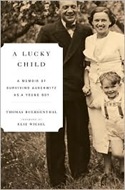
A Lucky Child


Thomas Buergenthal has indeed had luck play a role in his life, as he writes in A Lucky Child. Born in Czechoslovakia to German and Polish parents, Buergenthal had a few idyllic years growing up in the hotel his family owned. Hitler and the Nazi regime changed all that when he was still a small boy, turning his family out of their home. They journeyed to Poland where after a time they were placed in a Ghetto and eventually were transferred to Auschwitz. Buergenthal arrived in Auschwitz a ten year old boy, miraculously escaped the selection process and found himself a prisoner in a place where children did not fare well. Burgenthal survived the death march and another concentration camp before he was set free.

The story of Thomas Buergenthal is extraordinary in many ways. I cannot say I've ever read about a child surviving Auschwitz. Time and time again, the quick-thinking and creativity of his parents, and the luck of being in the right place and meeting the right people (or perhaps not being in the wrong place or meeting the wrong people) contributed to Buergenthal's capability to survive another day, to escape another close call.

Buergenthal goes on to travel with the Polish army after the war and is eventually and happily reunited with his mother after living in a Jewish orphanage. The portrait he paints of his life in Germany after the war is fascinating as well, being one of only a few Jewish people in his town. Buergenthal eventually emigrated to the US where he became a lawyer devoted to upholding international human rights, a job he is uniquely qualified for.

Buergenthal's story is simply told. He is honest about what events he remembers and which are not as clear. Buergenthal is an articulate and self-aware human being, who has shaped his life around avoiding hatred and upholding the rights of all. We are lucky indeed, to have this memoir, a unique document of a child who survived the Nazi concentration camps.

Many thanks to Hachette Book Group for this review copy. A Lucky Child will be published on April 20.

Monday, October 6, 2008

Agnes Humbert's Resistance


It is summertime in 1940 when Germany takes Paris. Soon after, Agnes Humbert bands together with a group of like-minded friends to publish Resistance - a French resistance newsletter. By the Spring of 1941 Humbert has been arrested, spends time in a French prison, and is then deported to Germany to a work camp. She suffers there until the end of the war, and while awaiting transport back to France, assists the Americans with their work in Germany.

Humbert wrote Resistance in 1946 shortly after the war, the beginning and end parts taken directly from her diary, the middle portion, by necessity written from memory, yet still in a diary format. This gives the book a strong sense of immediacy. I was feeling a bit lost in the opening pages of the book, there were many names and locations that I found difficult to keep track of. The story becomes quite intense when Humbert is arrested, tried and imprisoned. What is most striking in Humbert's writing is her sense of humor, her bravery, and her feistiness. Humbert finds herself working (slaving) in a rayon factory. I didn't know a thing about the manufacturing of rayon, but have discovered that it is quite dangerous and toxic. Humbert and her fellow prisoners are not given protective gear as the paid workers are, and the prisoners are suffering from terrible wounds, temporary blindness, and clothing that is disintegrating instead of covering them. Humbert suffers so much but never loses her sense of self and compassion for others.

Not only is Resistance an intensely personal story, it is an informative one as well. It was fascinating to read about the French Resistance and especially how its members were treated once imprisoned and charged. Resistance was out of print for many years, until Barbara Mellor the translator of this book, came across it and knew it was a story that transcended time. We have her to thank for bringing this story to our attention.

I end with a quote from Agnes Humbert from 1943, when she is thinking about her inanimate objects waiting for her at home:

I think about my books, especially: which one shall I open first when I get back? I can see my bookshelves, and the rows of my beloved books. By the time I get back I shall have quite forgotten how to read, and I'll have to start all over again by looking at picture books like a child.

Many thanks to Bloomsbury for giving me the opportunity to read and review this book.

Friday, August 15, 2008

On Hitler's Mountain


On Hitler's Mountain by Irmgard A. Hunt is the memoir of a woman who grew up in Germany during the reign of Hitler. She lived in a small Bavarian village that was overlooked by Obersalzberg, a hamlet where Hitler built his home and headquarters. On Hitler's Mountain begins with the story of Hunt's grandparents and parents who lived through WW1 and had never been in a financially stable position. The experience of this family, and probably many others, helps to understand in some ways how they came to elect Hitler German chancellor despite knowledge of his anti-semitism. This is an interesting book on many levels - growing up in Bavaria, growing up in Hitler's Germany with parents who supported Hitler, and especially life in occupied Germany after the war. I had really never understood before what happened when the allies occupied Germany, so the reading of this as well as additional research has been a good education for me.

This book is an important document, I think. I'm certainly not aware of many other books detailing life inside Germany during WW2, particularly from a child's point of view. As the author describes, in most cases, people in Germany at that time would prefer to forget which is understandable.

I had a difficult time with this book on an emotional level in ways that I'm not entirely comfortable with. Obviously life for Hunt and her family was difficult, living in Europe during WW2. The author made a great effort, in my opinion, in trying to give factual information and describe things how they were, not to gain sympathy but to educate. I continued to find myself, thinking, about the fact that yes, her life seemed uncomfortable, and yes, she was hungry, and no, she didn't get new clothes or toys, and the life she led is one no child should have to live. But. None of this compared in my mind to what everyone else in Europe was going through at the time. Even though it is utterly irrational on my part, I just couldn't help feeling that she didn't have it so bad in comparison. Though I struggled with these feelings throughout this book, I do recommend this book as an interesting perspective of this terrible time.

Friday, May 16, 2008

Sarah's Key

In July of 1942 the German army ordered the French police to round up Jewish citizens in Paris. The prisoners were brought to an indoor sporting arena called the Velodrome and the incident is now know as the Rafle du Vel' d'Hiv. The prisoners suffered for days in the Velodrome, eventually were removed and taken to a transit camp then on to Auschwitz.

This is the basis for the novel Sarah's Key by Tatiana de Rosnay. Sarah is 10 years old and is rounded up with her parents. She locks her younger brother in their secret hiding place promising to return soon. Julia is a journalist, an American married to a Frenchman, who is working on a story about the Vel' d'Hiv. Through her research Julia finds a disturbing link between her husband's family and that of Sarah's.

This book sounded so interesting to me and I was thrilled to get a copy from LibraryThings's Early Reviewer's program. The first half of the book is told from the alternating perspectives of Sarah and Julia. At first, it felt as though the author was going back and forth too quickly, but as Sarah's story became more intense the pace felt right, and Julia's story was a bit of a respite. During this part of the novel, I really couldn't put this book down. Sarah's voice was so authentic and she is a brave and heroic character. Halfway through the book, the story changes and is told only from Julia's perspective who is still researching what has occurred in the past. I didn't feel this part of the novel was as strong as the first. Even though Julia is respectful of the situation she had a self-centered way of approaching the story of Sarah - how it made her feel, how it affected her life - that bothered me. There is a climax about 30 pages before the end of the book and I felt that those last 30 pages were somewhat superfluous and didn't fit well with the rest of the story. I felt they would have been better condensed as a few page epilogue.

Despite my criticism, I found this book to be an absorbing and worthwhile read. I certainly was not aware of this event in French history and it remains a shameful memory because the French police assisted in the deportation.

Monday, May 12, 2008

A Find


Lazy, lazy, lazy. That's how I'm feeling right now. I worked all weekend so I'm taking it easy right now, still in my pajamas. Except I need to get some housekeeping done. Sigh.

I read a really fantastic book last week, The Master Butchers Singing Club by Louise Erdrich. This was a book club pick and though I've heard a lot about the author who lives here in town, I didn't know what to expect. This book was so good in fact, once I started this, I completely gave up on a book I was over 100 pages into that I wasn't really getting on with. The contrast between how well this was written and the other book was huge.

Fidelis Waldvogel returns to his small German village after serving in WWI. He marries and soon afterwards decides to try him luck in America. Alone, except for a suitcase full of sausage, Fidelis makes his way West, planning to go to Seattle, but winding up in Argus, North Dakota since that was as far as his money would take him. Fidelis sets up a business and brings his family over. Delphine Watzka, who grew up in Argus, is living on the road and performing in an act. She returns to Argus and her alcoholic father, and takes a job in Fidelis's shop forming a strong bond with Eva, Fidelis's wife. There the story takes off, all the way to post WWII, on the way there is life and death, love and animosity, murder and a bit of a mystery all woven together to tell this brilliant tale.

It's hard to put my finger on why I liked this book so very much. It's beautifully written but it's much more than that. The characters are so well drawn and complicated - they weren't just good or bad, but had many facets to their personalities. I felt as though I knew them and couldn't wait to get back to them. There are lots of bizarre situations but somehow Erdrich made them seem so possible, so real. It was just a really, really good read and one of the highlights this year. I hope my book club will have a good discussion about this one.

Erdrich is a member of the Ojibwe Indian tribe and apparently many of her books focus on these people and these small towns like Argus. She has written quite a few books and I'm trying to figure out what else would suit me. I have my eye on The Last Report on the Miracles at Little No Horse. I'm curious if you've read anything by her and if you have any recommendations.

Wednesday, March 19, 2008

1940s House


A huge thank you to whoever suggested I watch this wonderful program. The only other program in the 'House' series I'd previously seen was 1900s House, and though I liked it very much, my main recollection of it is of the mother of the family whining quite a bit about housework. I wasn't sure I wanted to see the 1940s version of this, but I'm so glad I did. I've written previously about wanting to really know about the effects of WW2 on Britain and how the war affected it's people - 1940s House is exactly what I was looking for.

In the 1940s house, the present day family arrives and gets to know their surroundings and how to cope with old ways of doing things. Soon, they are plunged headfirst into war life. I loved listening to the narrator speak about facts and statistics - one that has stuck with me was learning how many pets were put down in the first days of the war due to noise and expected food shortages. I loved watching the historians and experts meet in the Cabinet War Rooms and discuss the effect the war had on families, the expectations of families, and how the family would next be tested. I loved hearing the original BBC broadcasts of the news and the newspapers.

I feel as though I now understand the story behind the story of so many books I have read, and so many that I will read in the future. I have a better understanding of this period of time and of what people really dealt with. I enjoyed the journey of this family as well. They especially struggle with rationing and hunger. It is fascinating to see the women go out and 'do their part' for the war. At times, they were discouraged and seemed to have taken on too much, but time and time again, they rose to the challenge as people really would have done. I enjoyed seeing the footage of the lives 6 months after the project ended. Not to give anything away, but I loved when one of the children said something to the effect of "Granny used to be a cool Granny - now she's gone bonkers." Not only does the program have great entertainment value, I think it would be a useful teaching tool for young people. Some many of us don't understand what went on and why people are the way they are after what they went through. My only complaint is that I wished the program were longer than 3 hours. I could have watched at least a couple more.